
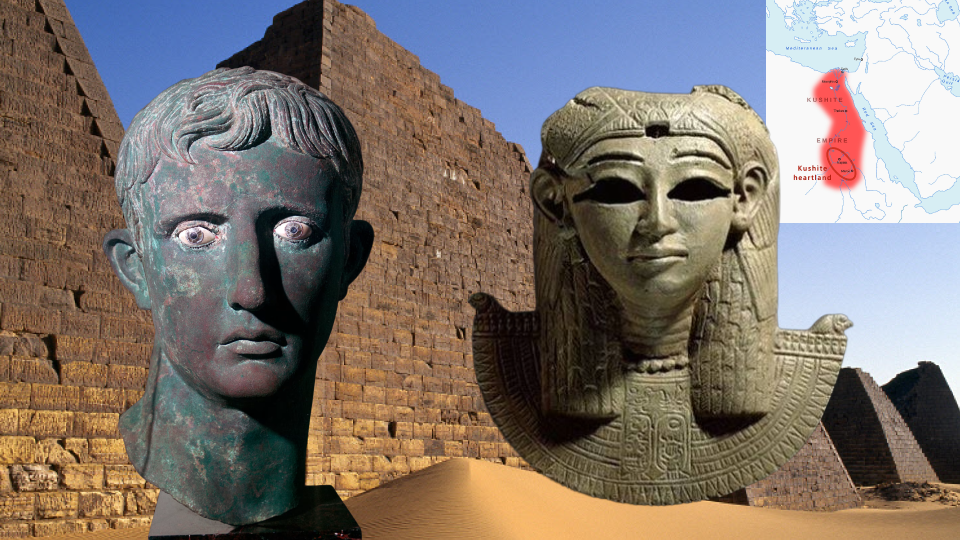
Ask most people what they know about ancient Egypt and you’ll get pyramids, pharaohs, maybe Cleopatra. Ask them what they know about the kingdom directly south of Egypt, the one that conquered Egypt, ruled it for nearly a century, built more pyramids than Egypt ever did, and later fought the Roman Empire to a standstill, and you’ll get silence.
That was the Kingdom of Kush. The silence around it is not an accident of history. It’s a choice historians made for a very long time, and one Vocal Africa intends to keep correcting.
Before Egypt Was Even an Empire
Kush sat along the Nile in what is now northern Sudan, in a region the Egyptians called Nubia. Long before anyone called it “Kush,” there was Kerma, a city-state that by 2500 BCE controlled territory along the Nile Valley as large as Egypt itself and rivaled it in wealth and power. This wasn’t a frontier outpost of Egyptian civilization. It was Egypt’s competitor, sitting right at its southern border, for over a thousand years.
Egypt eventually absorbed Nubia during its New Kingdom period, around 1550 BCE, and for centuries Kush existed in Egypt’s shadow. But empires fall, and when Egypt’s New Kingdom collapsed around 1070 BCE, the Nubians didn’t wait for permission. They built their own kingdom, with their own capital at Napata, and called it Kush.
Then they did something most conquered peoples never get the chance to do. They turned around and conquered their conquerors.
The Black Pharaohs Who Ruled Egypt
In 727 BCE, a Kushite king named Piye looked at a fractured, weakened Egypt and decided he wasn’t going to watch from the south anymore. He marched his army north, defeated a coalition of Egyptian rulers, and took Memphis. Piye didn’t frame this as a foreign invasion. He saw himself as the rightful restorer of order, a defender of the god Amun against Egyptian rulers he considered illegitimate. He had his soldiers purify themselves in the Nile before battle. He modeled himself after Egypt’s greatest pharaohs. And then he became one.
![Statues of various rulers of the late 25th Dynasty–early Napatan period. From left to right: Tantamani, Taharqa (rear), Senkamanisken, again Tantamani (rear), Aspelta, Anlamani, again Senkamanisken; Kerma Museum.[1] of Twenty-fifth Dynasty of Egypt](https://vocalafrica.com/wp-content/uploads/2026/06/Rulers-of-Kush-The-Black-Pharaohs-Who-Ruled-Egypt-1024x836.jpg)
This was the start of Egypt’s 25th Dynasty, a line of Kushite kings who ruled Egypt for nearly 75 years. Piye. Shabaka, who moved the capital to Memphis and commissioned the copying of ancient Egyptian religious texts to preserve them. Shebitku. And Taharqa, the most famous of them all, who expanded Kushite influence as far as Libya and Phoenicia, built more pyramids in Nubia than any king before him, and spent years holding off the Assyrian Empire before finally being pushed back to Napata.
History has a name for these rulers: the Black Pharaohs. It’s worth sitting with that for a second. The most powerful kingdom in the ancient world’s most famous civilization was, for three-quarters of a century, run by African kings from further up the Nile. Most people have never heard their names.
The Pyramids Nobody Talks About
Here is a fact that should be more famous than it is. There are more pyramids in Sudan than in Egypt, over 200 of them, built by Kushite kings at Napata and later at Meroe, with the same religious purpose as their Egyptian counterparts but a distinct architectural style: steeper, smaller, unmistakably their own.
When the Egyptian army eventually pushed back against Kushite rule and sacked Napata in 593 BCE, the Kushites didn’t collapse. They moved their capital south to Meroe and kept building.
Meroe: The Kingdom That Outgrew Egypt’s Shadow
Meroe changed everything for Kush. It sat further from Egypt’s reach, had better rainfall, and didn’t depend on the Nile floods the way Napata had. Kushite farmers expanded what they could grow: cotton, sorghum, millet. Cattle became central to both the economy and the culture.
But Meroe’s real claim to fame was iron. The city became one of the ancient world’s most significant iron-working centers, smelting and forging on a scale that influenced metallurgy across sub-Saharan Africa for generations afterward. Some historians have called Meroe “the Birmingham of Africa,” a reference to England’s industrial iron city, though the comparison undersells it. Meroe was producing advanced ironwork centuries before Birmingham existed.
As Meroe grew wealthy from iron, gold, ivory, and trade routes connecting inland Africa to the Red Sea, it also grew culturally independent. Egyptian gods faded into the background. Kushite deities took center stage instead, like Apedemak, the lion-headed war god, worshipped with actual lions kept at his temples. Kush stopped being a kingdom that lived in Egypt’s reflection and became fully, distinctly itself.
The Queen Who Made Rome Blink
If there’s one story from Kush that deserves to be far better known, it’s this one.
In 30 BCE, Rome conquered Egypt and Augustus became the most powerful man in the ancient world. Roman forces pushed south into Kushite territory and tried to impose taxes on land that belonged to Kush. The queen ruling Kush at the time, Amanirenas, who carried the royal title kandake, said no.
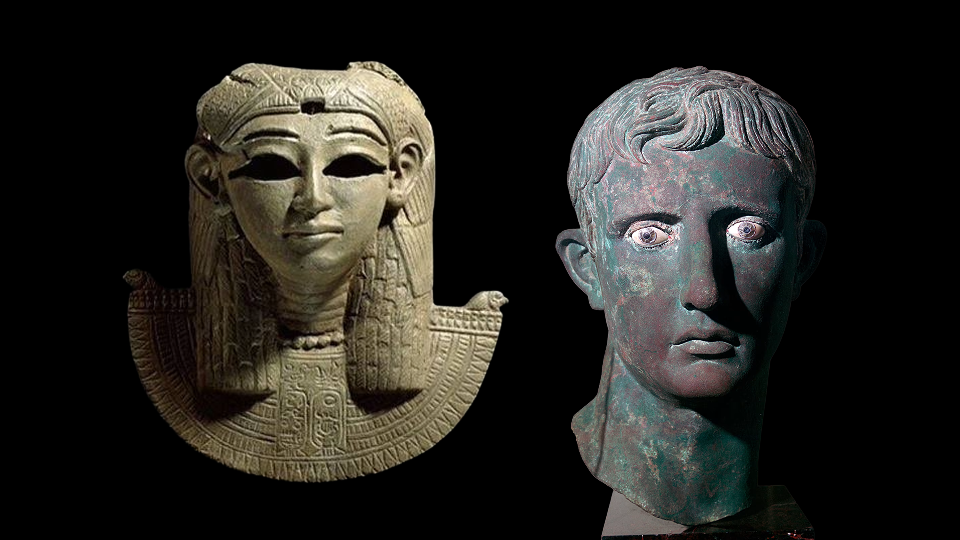
Kush had a long tradition that most of the ancient world didn’t: queens who ruled in their own right, not as placeholders for absent kings. Amanirenas wasn’t a regent. She was the kandake, full stop, and when Rome encroached on her kingdom, she didn’t send a diplomat. She sent an army of roughly 30,000 soldiers.
The Kushite forces struck while Roman troops were stretched thin on a campaign in Arabia. They captured Aswan, Philae, and Elephantine. In the process, Kushite soldiers tore down a statue of Augustus and carried its bronze head over a thousand kilometers back to Meroe, where they buried it under the steps of a temple, positioned so that everyone entering would walk over the face of the Roman emperor for the rest of Kush’s history. That head, the famous “Meroë Head”, was dug up by archaeologists in 1910. It’s in the British Museum today, still missing the body Kush never gave back.

Rome counterattacked. Amanirenas reportedly lost an eye in the fighting. Strabo, the Greek geographer, recorded that the Romans took to calling her the “one-eyed Kandake”. She kept fighting anyway. The war dragged on for years until both sides were exhausted, and Augustus, busy managing the Parthian Empire on Rome’s eastern front, agreed to a peace deal that favored Kush. Rome pulled its frontier back. Kush kept its independence. The peace held for nearly three centuries.
Sit with that. Most of the people Rome went to war with ended up provinces. Kush ended up with a peace treaty written on its own terms, negotiated by a queen who had already taken Augustus’s head as a trophy.
Why This History Got Buried
None of this is secret information. It’s documented in Greek and Roman sources, in Kushite inscriptions, in archaeology that UNESCO recognized when it named the pyramids of Meroe a World Heritage Site in 2011. The Meroitic script, Kush’s own writing system, still hasn’t been fully translated by modern scholars, which tells you how much of this history we genuinely haven’t finished uncovering yet.
So why isn’t Kush part of the standard story people tell about the ancient world?
Partly it’s geography. Kush sat outside the Mediterranean world that produced most of the historians whose work survived. Partly it’s the long shadow of 19th and 20th century scholarship that was far more comfortable crediting “Black Pharaohs” to outside influence than admitting an African kingdom built its own empire, ruled Egypt as conquerors rather than subjects, and stopped Rome’s expansion cold. And partly, frankly, it’s because the story of Africa that got exported to the rest of the world was never written by people who had a reason to tell this one.
Kush existed in some form for nearly 3,000 years. It outlasted multiple Egyptian dynasties. It produced more pyramids than Egypt. It gave the ancient world some of its only confirmed warrior queens ruling in their own name. And it made an emperor of Rome decide that peace was cheaper than pride.
That’s not a footnote. That’s a superpower. It’s just one that got written out of the story, and one we’re putting back in.
Did you know more pyramids exist in Sudan than in Egypt? Tell us what surprised you most about Kush in the comments, and if you want more of the African history they didn’t teach you in school, that’s exactly what we’re here for.