Marrakech is a city that doesn’t just sit there; it pulses. From the moment the sun hits the pink-tinted walls of the Medina to the second the smoke starts rising from the food stalls at dusk, it’s a sensory overload in the best possible way. Known as the “Ochre City,” Marrakech is a place where medieval history and modern luxury sit side-by-side, sometimes sharing the same narrow alleyway.
If you’re planning a trip in 2026, you’re likely looking for more than just a checklist. You want to know where to find the soul of the “Red City.” Whether you’re here for the history, the food, or the sheer chaos of the markets, here are the top 15 places to visit in Marrakech that you simply cannot miss.
Top Places to Visit in Marrakech This Year
1. Jemaa el-Fnaa: The Beating Heart
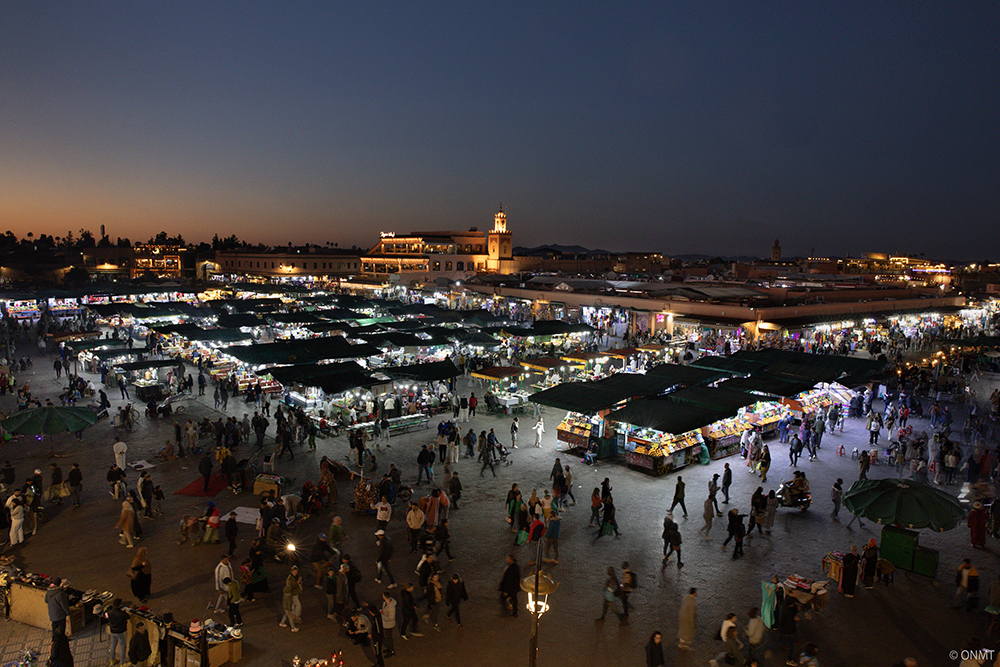
Every journey in Marrakech begins and ends here. By day, Jemaa el-Fnaa is a sprawling open square filled with orange juice vendors, water sellers in traditional tasseled hats, and henna artists. It feels like a standard tourist hub until the sun begins to dip.
As dusk falls, the square transforms into an open-air theater. The “Chiringuitos” (food stalls) appear almost out of thin air, numbered and emitting clouds of fragrant smoke. You’ll find storytellers (the hikawati) captivating local crowds, Gnaoua musicians, and rows of communal tables.
Must-try: Snail soup (Babbouche) is a local delicacy said to aid digestion, but if you’re not feeling adventurous, the grilled lamb brochettes are world-class.
Pro Tip: Head to a rooftop cafe like Le Grand Balcon du Café de la Poste or Café de France just before sunset. The view of the square coming to life under the call to prayer (Adhan) echoing from the Koutoubia is a spiritual experience.
2. Jardin Majorelle: An Oasis of Blue
If there is one image that defines Marrakech, it’s the vibrant “Majorelle Blue” of this botanical garden. Originally created by French painter Jacques Majorelle over forty years, it was later rescued and restored by fashion icon Yves Saint Laurent and Pierre Bergé.
It’s a peaceful retreat from the city’s noise, featuring rare cacti, bamboo groves, and lily ponds. The contrast between the electric blue buildings and the towering green cacti makes it a photographer’s dream. The garden also houses the Berber Museum, which offers a deep dive into the indigenous culture of Morocco through jewelry and textiles.
Timing: Go as soon as it opens at 8:00 AM. By 10:30 AM, the crowds can make it hard to enjoy the serenity.
Related Post: What are the Best Safari Destinations in Southern Africa
3. Ben Youssef Madrasa: Architectural Perfection
Recently restored to its full glory, this 14th-century Islamic college is arguably the most beautiful building in Morocco. At its peak, it housed over 800 students who were studying the Quran.
The central courtyard is a masterclass in Islamic architecture: zellige tilework, carved cedarwood from the Atlas Mountains, and intricate stucco. Standing in the center and looking up at the small student rooms above, you get a real sense of the city’s golden age of learning. The symmetry here is almost hypnotic, designed to reflect the perfection of the divine.
4. The Souks: Getting Lost on Purpose
You can’t talk about places to visit in Marrakech without mentioning the labyrinthine markets. The Souks are organized roughly by craft, and as you walk deeper, you’ll hear the rhythm of the city change from the banging of metal to the soft scraping of leather.
Souk Cherratine: Where the leather bags and belts are made.
Souk des Teinturiers: Famous for the vibrant dyed wool hanging to dry in the sun.
Souk el Attarine: The spice market, where the air is thick with the scent of cumin, saffron, and Ras el Hanout.
Haggling: This is a social sport. Never take the first price. Offer roughly 40% and work your way to a middle ground. If you can’t agree, walk away—often, they will call you back.
5. Bahia Palace: The “Brilliance”
Built in the late 19th century by Si Moussa, the Grand Vizier of the Sultan, the Bahia Palace was intended to be the greatest palace of its time. “Bahia” means brilliance, and it lives up to the name.
The palace features 150 rooms, but the real star is the Grand Cour d’Honneur. This vast courtyard, paved in Italian marble and adorned with yellow and blue tiles, was once the reception area for the Sultan’s guests. The intricate painted ceilings in the harem section are particularly stunning, showing the wealth and craftsmanship of the Alawite era.
6. Koutoubia Mosque: The North Star
The 77-meter minaret of the Koutoubia Mosque is the landmark that helps you find your bearings whenever you’re lost. It is the largest mosque in Marrakech, and its design influenced the Giralda in Seville and the Hassan Tower in Rabat.
While non-Muslims cannot enter the mosque itself, the surrounding gardens are a lovely place for a stroll, especially in the late afternoon. At night, the tower is lit up, casting a golden glow over the nearby square. It serves as a reminder of the city’s Almohad roots and the enduring power of faith in daily life.
7. Saadian Tombs: A Royal Secret
Hidden for centuries behind a wall in the Kasbah, these tombs were only rediscovered by French aerial photography in 1917. They serve as the final resting place of the Saadian dynasty, who ruled during Morocco’s golden age.
The “Chamber of the Twelve Columns” is the highlight, featuring Italian Carrara marble and gilded honeycomb (muqarnas) carvings. It is a somber, quiet place that feels worlds away from the hustle of the nearby Medina. The gardens between the tombs are filled with rosemary and orange trees, making it one of the most peaceful spots in the city.
8. El Badi Palace: The Incomparable Ruins
Once a lavish palace encrusted with gold, turquoise, and crystal, El Badi is now a haunting set of ruins. It was stripped of its riches by the later Sultan Moulay Ismail, who used the materials to build his own palace in Meknes.
Today, El Badi is famous for its massive sunken gardens and the storks that build giant nests atop the ancient ramparts. Walking through the underground tunnels where prisoners and servants once lived provides a stark contrast to the vastness of the courtyard above. It’s a great place to reflect on the transience of power.
9. Maison de la Photographie: A Window to the Past
Located in a quiet riad in the northern Medina, this museum houses an incredible private collection of vintage Moroccan photography from 1870 to 1950. It’s a moving look at how the people and landscapes of Morocco have evolved.
The black-and-white portraits of Berber tribesmen and the early shots of the Jemaa el-Fnaa show a side of Morocco that remains unchanged in spirit.
Bonus: Their rooftop terrace is one of the highest in the Medina. It’s a perfect, quiet spot to enjoy a mint tea while looking out over the rooftops toward the Atlas Mountains.
10. The Mellah: The Jewish Quarter
To understand the true diversity of Marrakech, you have to visit the Mellah. Established in the 16th century as a refuge for Jews fleeing the Spanish Inquisition, this area has a distinct architectural feel—balconies face the street, unlike the inward-facing Arabic riads.
Don’t miss the Lazama Synagogue, a beautiful blue-and-white courtyard house that now serves as a museum of Jewish-Moroccan history. Nearby, the Miaâra Jewish Cemetery is a striking, somber expanse of white tombs against the red city walls.
11. Le Jardin Secret: A Hidden Sanctuary
Tucked behind an unassuming door in the middle of the busy Mouassine district, Le Jardin Secret is a restored palace complex with two distinct gardens: an exotic garden with plants from around the world and a traditional Islamic garden.
The Islamic garden is a representation of paradise as described in the Quran, divided into four quadrants by water channels. The precision of the ancient khettara (underground irrigation) system is showcased here, providing a much-needed “reset” button for your senses after the chaos of the souks.
12. Dar Si Said: The Museum of Weaving
Often overlooked for the more famous palaces, Dar Si Said is actually the oldest museum in the city. It’s housed in a beautiful 19th-century mansion and focuses on Moroccan craftsmanship, specifically woodwork and carpets.
If you’re planning on buying a rug during your trip, come here first. The museum explains the difference between the geometric patterns of the Middle Atlas and the colorful, abstract weaves of the High Atlas. Understanding the symbolism behind the “lozenge” or “Z” patterns makes shopping in the souks much more meaningful.
13. Menara Gardens: The Local Hangout
Located about a 45-minute walk from the city center, the Menara Gardens feature a huge basin of water built to irrigate the surrounding olive groves. It is anchored by a green-tiled pavilion that dates back to the Saadian era.
This isn’t a “manicured” garden like Majorelle; it’s where local families go on weekends to picnic and escape the heat. On a clear day, the reflection of the pavilion with the snow-capped Atlas Mountains in the background is the quintessential Marrakech postcard shot. It is a place for slow walks and people-watching.
14. Dar El Bacha: Coffee and Culture
Formerly the residence of Thami El Glaoui, the Pasha of Marrakech, this palace now houses the Museum of Confluences. The architecture is some of the finest in the city, with intricate cedar ceilings and vibrant floor tiles.
However, many visitors come specifically for Bacha Coffee. It is an opulent, wood-paneled room where you can choose from over 200 types of Arabica coffee.
Strategy: There is almost always a waitlist of 1-2 hours. Put your name down at the host stand as soon as you arrive, then explore the museum and the boutiques in the Dar El Bacha district while you wait for your text notification.
15. The Tanneries: An Ancient Craft
A visit to the tanneries is a glimpse into a process that hasn’t changed in a thousand years. Located at the edge of the Medina (Bab Debbagh), this is where leather is treated using traditional methods.
You’ll see workers standing in vats of pigeon droppings (used for its ammonia to soften the hide) and natural dyes like poppy (red) and saffron (yellow). It is intense, pungent, and fascinating.
The Mint Sprig: You will likely be handed a sprig of mint to hold under your nose to mask the smell. Use it. Also, be aware that many “guides” will offer to take you there; agree on a small tip beforehand to avoid an awkward encounter at the end.
How to Get Around around Marrakech
- Walking: Inside the Medina, walking is your only real option. Download an offline map like Maps.me, as Google Maps often struggles with the narrow, covered alleys.
- Petit Taxis: These small beige cars are perfect for short trips outside the Medina. Always ask the driver to “Mettez le compteur” (put on the meter). If they refuse, agree on a price before getting in—usually 20-30 DH for a short city hop.
- Calèches: Horse-drawn carriages are a romantic way to see the city walls or travel to the Menara Gardens.
Before You Go
Marrakech is a city of layers. You might come for the famous places to visit in Marrakech, but you’ll stay for the moments in between—the smell of fresh bread, the sound of the metalworkers’ hammers, and the warmth of a Moroccan welcome. It is a city that requires patience, a sense of humor, and a willingness to get a little bit lost.